Creating paid ads usually takes more than writing a headline and uploading a product photo. You need visuals, hooks, scripts, formats, campaign settings, testing, and enough creative variations to learn what actually works.
That’s where Zeely AI ads come into the picture. Zeely is built around AI-assisted advertising, allowing businesses to create video and image creatives, generate variations, launch campaigns, and analyze performance from one platform.
For small businesses and online sellers, the appeal is straightforward: less manual production work and more opportunities to test different advertising ideas. The bigger question is whether the platform fits your workflow and how much control you want over the final ads.
What Are Zeely AI Ads?
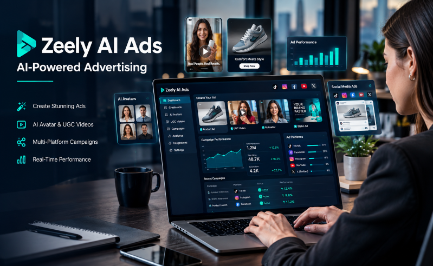
Zeely AI ads are advertising creatives and campaign tools generated or supported by Zeely’s artificial intelligence platform. The service can create video ads, static image ads, UGC-style content, and other marketing materials from product information and visual assets.
Zeely says its platform combines multiple AI models with performance-marketing frameworks. Its current system can help with the creative process, campaign setup, performance tracking, and identifying stronger-performing ads.
The platform is designed particularly around businesses that want to produce advertising content without relying entirely on professional filming, actors, designers, or editors.
Its current advertising workflow includes several areas:
- AI video ads and UGC-style videos
- Static image advertisements
- Ad variations for testing
- AI avatars and talking-head videos
- Campaign launch tools
- Creative performance analytics
- Competitor-ad research
- Organic social content
That makes Zeely more than a simple AI image generator. It aims to connect creative production with the advertising process itself.
How Do Zeely AI Ads Work?
The basic workflow starts with your product or service. You can provide product information, upload an image, or use other available assets depending on the type of creative you’re building.
For video ads, Zeely’s current help documentation describes a workflow where you select a product, choose an asset, select a reference style, and allow the system to generate the video.
Step 1: Add Your Product
Start with the product or service you want to promote. Product information gives the AI context for creating the advertisement.
A stronger product description generally gives you more useful material to work with because the AI has more information about the offer, audience, and positioning.
Step 2: Choose a Creative Format
You can create different types of advertising content, including static ads and video ads.
For video, you can use AI avatars and UGC-style formats. For image campaigns, Zeely provides templates and variations designed for different advertising concepts.
Step 3: Generate and Refine
After selecting your creative direction, Zeely generates the content. You can then review the result and make changes rather than treating the first AI output as final.
This step matters. AI can produce a usable starting point quickly, but your product knowledge still helps determine whether the message actually makes sense for your customers.
Step 4: Launch and Track
Zeely also provides tools for launching paid campaigns and monitoring creative performance. The current platform focuses particularly on Meta advertising while continuing to develop additional channel capabilities.
That creates a workflow where you can move from idea to creative to campaign without constantly switching between different tools.
Why Businesses Use Zeely AI Ads
The biggest attraction is speed.
Traditional advertising production can involve a photographer, video editor, designer, copywriter, actor, and media buyer. A small business may not have the budget or time to coordinate all of them for every new creative.
Zeely attempts to reduce that production burden.
Faster Creative Testing
Advertising improves through testing, but testing requires variations. One headline isn’t enough, and one product image doesn’t tell you which creative angle your audience prefers.
Zeely can generate multiple creative variations, allowing advertisers to experiment with different hooks, visuals, messages, and formats.
Lower Production Requirements
You don’t necessarily need a camera crew or physical studio to create a UGC-style advertisement. AI avatars can deliver scripts while generated visuals provide the creative material.
This can be useful for small sellers who need content frequently but don’t want to organize a production shoot every time they launch a new product.
One Workflow
Another advantage is having creative creation and advertising tools in one place.
Instead of creating an image in one application, writing copy in another, editing a video somewhere else, and manually organizing campaign data, you can handle more of the process inside the same ecosystem.
How to Create Better Zeely AI Ads
AI doesn’t automatically make an advertisement effective. Your input still matters.
Start with one clear customer problem. If the ad tries to explain everything about your product in 15 seconds, the message can become difficult to follow.
A better creative usually has a simple structure:
- Identify the customer’s problem.
- Introduce the product as a possible solution.
- Show how it works.
- Explain the main benefit.
- Give the viewer a clear next step.
Your product image also matters. Use a clean, high-quality image whenever possible because the visual becomes part of the foundation for the generated creative.
Then create several concepts instead of relying on one version. Test different hooks and messages while keeping the core offer consistent.
Finally, review every generated advertisement before publishing it. AI-generated content can contain awkward wording, inaccurate product details, unnatural visuals, or claims that don’t match your actual offer.
Common Mistakes to Avoid
One of the easiest mistakes is assuming that AI-generated means ready to publish.
It doesn’t.
Before spending advertising money, check the product name, price, claims, captions, voiceover, visual details, and call to action.
Another mistake is generating dozens of variations without a testing strategy. More ads don’t automatically mean better results. You need to understand what you’re testing.
For example, changing the hook while keeping the rest of the creative similar can tell you more than changing the hook, audience, offer, image, and CTA simultaneously.
Avoid exaggerated claims, too. If your product doesn’t genuinely deliver a specific result, don’t allow an AI-generated script to promise it.
A simple quality-control checklist can help:
- Is every product detail accurate?
- Does the opening hook make sense?
- Is the benefit easy to understand?
- Does the visual actually show the product correctly?
- Is the CTA appropriate?
- Does the advertisement follow the platform’s rules?
That final review remains your responsibility.
Are Zeely AI Ads Good for Small Businesses?
Zeely’s feature set is particularly relevant to small businesses and online sellers that need frequent advertising creatives without building a large production team.
The platform can be useful when your biggest problem is creative production. If you already have a professional creative department, advanced media-buying team, and established production workflow, some of Zeely’s automation may overlap with tools you already use.
The best fit depends on what you’re trying to solve.
If you’re spending hours creating basic product advertisements, AI automation can reduce that workload. If your biggest problem is product-market fit, pricing, targeting, or a weak offer, generating more advertisements won’t fix the underlying issue.
Think of Zeely as a production and marketing assistant rather than a replacement for good marketing judgment.
Zeely AI Ads: What Should You Test First?
If you’re new to the platform, don’t start by creating 50 completely different advertisements.
Begin with three or four clear creative concepts.
For example, you could test:
- A problem-focused video
- A product-demonstration video
- A customer-benefit image ad
- A UGC-style testimonial concept
Keep the product and offer consistent while changing the creative angle. That gives you a cleaner comparison.
Once you identify a concept that attracts useful engagement, create additional variations around that idea.
The goal isn’t simply to produce more content. It’s to discover which combination of message, visual, format, and audience produces the strongest business result.
Frequently Asked Questions
What are Zeely AI ads?
Zeely AI ads are advertising creatives and campaign tools created with Zeely’s AI platform. They include video ads, static advertisements, UGC-style content, and creative variations.
Can Zeely create video advertisements?
Yes. Zeely supports AI-generated video advertisements, including UGC-style videos and AI-avatar content. Its current workflow allows users to select a product and creative reference before generating the video.
Do Zeely AI ads require a camera?
Not necessarily. Zeely’s AI-avatar and generated-video features are designed to create advertising content without requiring traditional filming or actors.
Can Zeely create image ads?
Yes. Zeely provides AI-generated static advertisements and templates that can be adapted for different products, messages, and creative concepts.
Can Zeely launch paid campaigns?
Yes. Zeely currently provides tools for launching paid campaigns, with Meta advertising integrated into its current performance-marketing workflow.
Should every AI-generated ad be published immediately?
No. Review each creative before publishing. Check product information, claims, visuals, scripts, captions, and calls to action to make sure everything accurately represents your business.
Are Zeely AI ads suitable for beginners?
They can be useful for beginners because the platform brings creative generation and advertising workflows together. However, beginners still need to understand their audience, offer, budget, and advertising goals.
Conclusion
Zeely AI ads can simplify a part of advertising that often consumes significant time: producing and testing creative content. The platform combines AI-generated videos, static ads, creative variations, campaign tools, and performance insights into a broader advertising workflow.
The best way to approach it is to treat AI as an accelerator rather than a substitute for marketing judgment.
- Start with a clear customer problem.
- Create several focused creative concepts.
- Review every AI-generated asset before publishing.
- Test variations instead of guessing.
- Scale the creatives that produce meaningful results.
When your offer is strong and your testing process is disciplined, Zeely AI ads can become a practical part of a modern advertising workflow.